What is this project?
ECO Merchant is an app that helps small grocery stores order products directly from brands and distributors. This makes restocking faster and cheaper for store owners.
220,000+ merchants. But users were unhappy with the experience, and two big competitors, VinShop and Telio, were growing fast. The company needed to redesign the app to keep up.
I joined as the product designer. My first project was to redesign the whole app. I owned the full process end-to-end: from organizing research and competitive analysis, building the design library, and delivering final UI for handoff.
What problem are we solving?
The app had not been updated for a long time. Users were having trouble with basic tasks. Three problems stood out clearly.
Our goal was not only to make the app look better. We needed to make it more useful, without confusing existing users who already knew the old version.
What did we learn from users?
We gathered data from three sources: a qualitative survey with 1,080 merchants nationwide, in-store interviews with 8 merchants, and a feedback log of reported issues.
Survey overview
Key findings
In-store interviews
We visited 8 grocery store owners to understand their daily routines, how they compare apps, and what frustrates them most.
"Wherever is cheaper, I buy there. Promotions have a big effect on my buying decision."
Chị Thúy, grocery store owner, Ho Chi Minh City
"Sometimes I need stock urgently on the same day. I cannot control inventory in detail, and the app doesn't tell me when things will arrive."
Chị Thúy, grocery store owner
"Tracking refunds takes time and gives me a headache."
Chị Thương, grocery store owner, Ho Chi Minh City
"I want to buy from my usual supplier, but they are not on the app."
Grocery store owner
What were the real problems?
Combining all three research sources, we identified six pain points that directly shaped our design decisions.
How did we compare to the competition?
We studied two main competitors in Vietnam: VinShop and Telio. Both had been in the market for several years and had large numbers of merchants using their apps.
We listed every feature in each product, compared them side by side, and shared the results with product, sales, and business teams. The goal was not to copy everything competitors had, but to find where we could do something better.
| Feature | ECO Merchant | VinShop | Telio |
|---|---|---|---|
| Quick reorder | No | Yes | Partial |
| Estimated delivery time | No | Yes | Yes |
| Promotions visibility | Basic | Advanced | Advanced |
| Filter by distributor (NPP) | No | Partial | Yes |
| Membership / loyalty tier | No | Yes | No |
| Favorite / personalized services | No | No | No |
| Daily price notification | No | No | Yes (via message) |
The table showed clear gaps in our product. But it also revealed an opportunity: no competitor offered personalized VAS or a visible membership tier. These became our 30% innovations.
How did we approach the redesign?
Merchants use many apps every day, Shopee, Lazada, Telio, Zalo. They already know how a shopping app should work. If we create something completely new, they have to learn it from scratch. That takes time they do not have.
So we made a decision early: follow familiar patterns first, improve on top of them second.
"Users spend most of their time on other apps. They expect your app to work the same way as the ones they already know."
Jakob's Law
- Search bar at the top
- Cart icon in the top right corner
- Same bottom navigation tabs
- Familiar product listing layout
- Checkout flow matching known steps
- Membership tier on Profile screen
- "Favorite services" on VAS page
- Three shopping shortcuts on Homepage
- Order status visible at a glance
The 30% was not about making things look different. It was about making things work better for how merchants actually live their day, always busy, always comparing prices, always needing information fast.
What did we change?
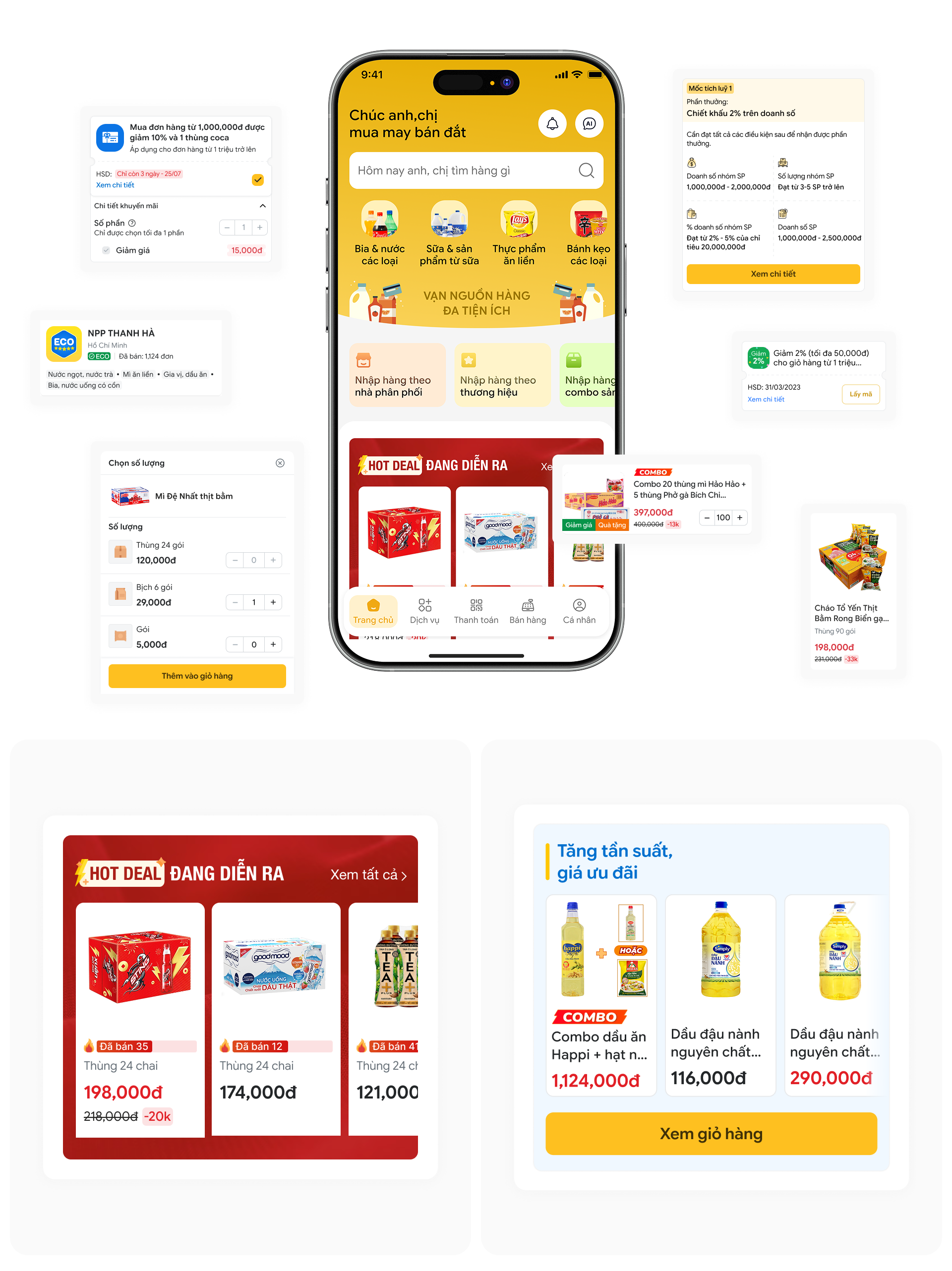
Research showed merchants restock in three specific ways: from a trusted distributor, by browsing category, or by the brand they already know. The old homepage had no shortcut for any of these. Merchants had to search from scratch every time, even for products they ordered every week.
We redesigned the homepage to match these real behaviors. Each restocking pattern now has a direct shortcut. We kept search, cart, and category bar in familiar positions, so nothing felt foreign to existing users.
- Added Hot Deal section with clear promotion labels
- Added three shopping shortcuts: order by distributor / browse by category / brands
- Larger tap targets and cleaner font sizes throughout
- Removed low-use content blocks from the first screen
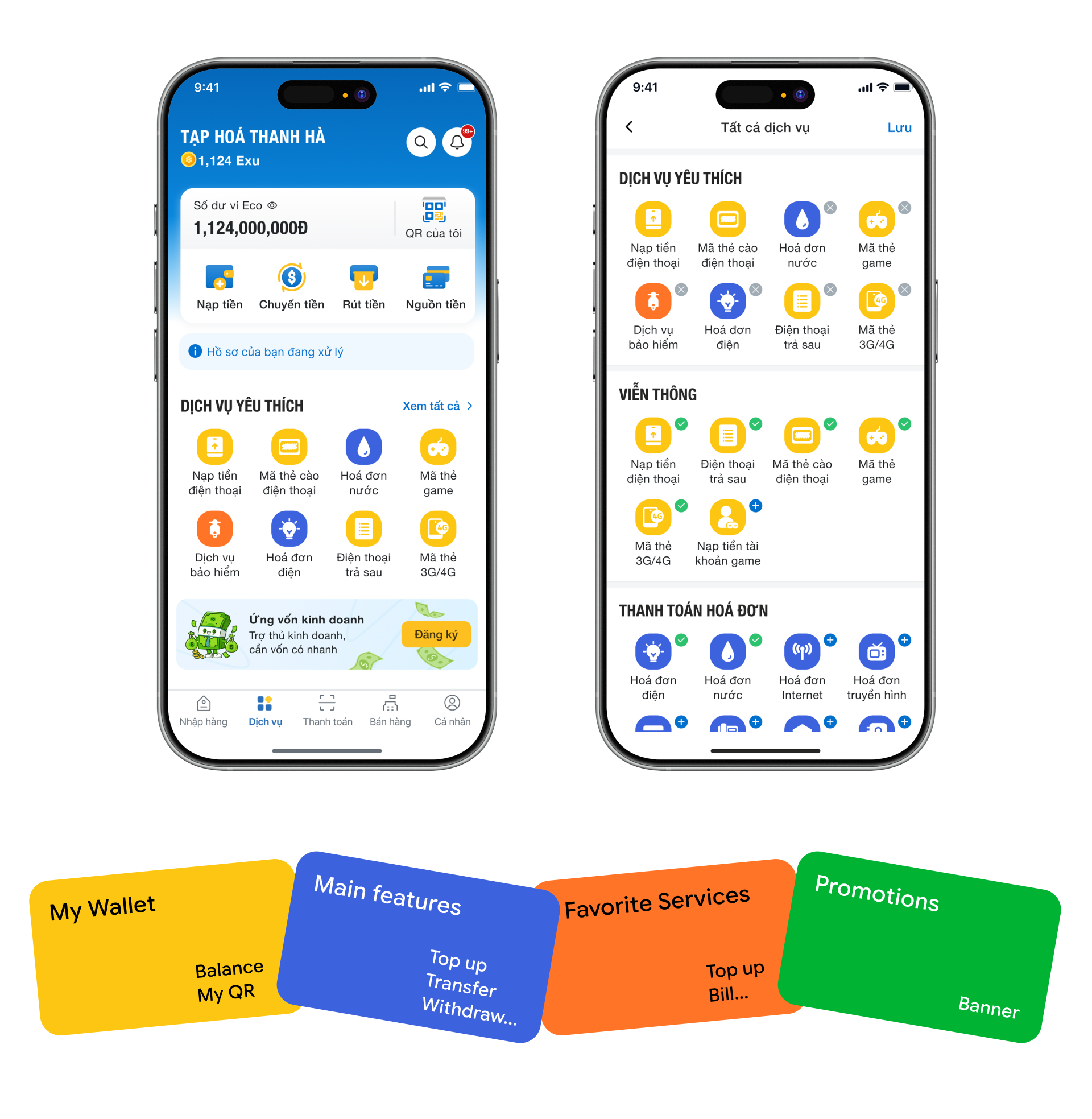
41.5% of merchants were already using value-added services like bill payment, top-up, and business insurance. But the old VAS page was a plain list with no color, no search, and no way to save favorites.
Different merchants need different services. We added a "Favorite services" feature so merchants can pin the services they use most. No competitor offered this.
- Reorganized layout, most-used services appear first
- Added a search bar for direct service access
- Added colors to icons, services are now visually distinct
- Added "Favorite" feature, merchants customize their shortcuts
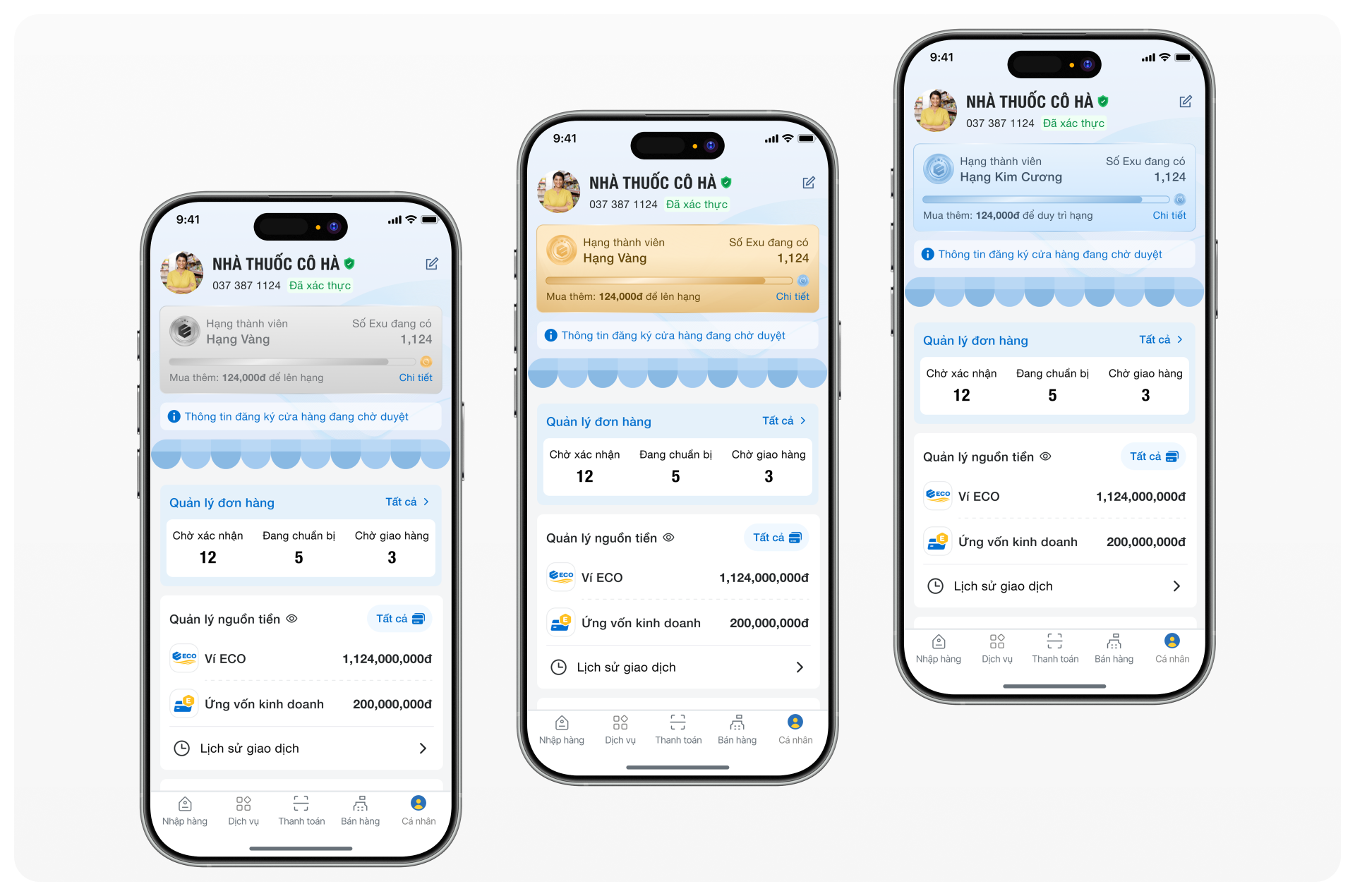
From interviews, we learned that when a merchant opens Profile, they check one of three specific things: wallet balance, order status, or membership level. Always in that order, because these are the most time-sensitive.
We redesigned the screen to match exactly that priority. All three are now visible at the top without scrolling. The membership tier was a new feature, no competitor offered this.
- Membership tier and loyalty points moved to the top
- Order summary (waiting / preparing / shipping) visible at a glance
- Financial summary (ECO wallet balance) grouped clearly
- Section dividers added for visual clarity
- Verification status visible so merchants know if action is needed
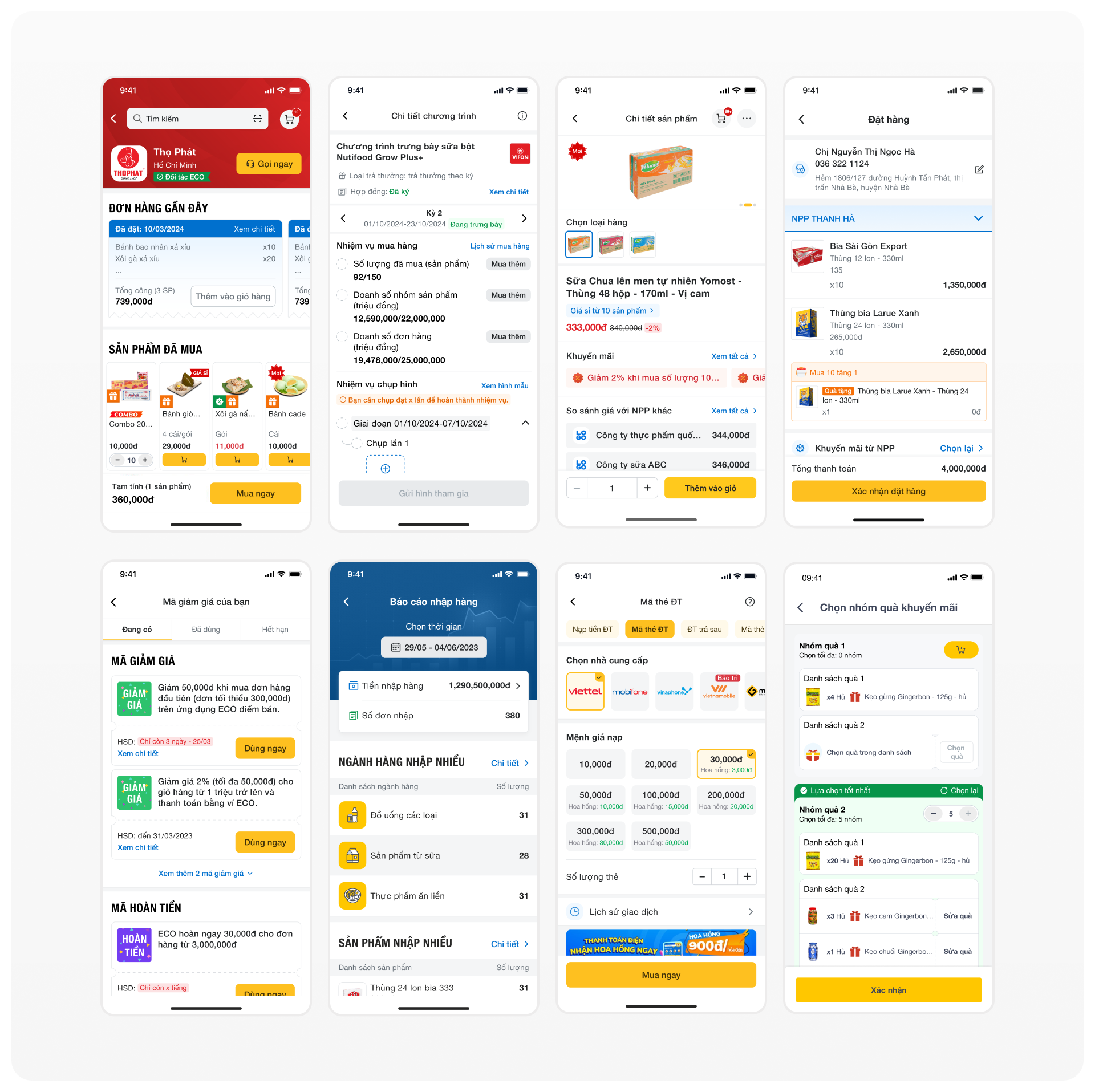
Another Screens
What made this project hard?
- 1 No design system existed. The old app had no component library. I built one from scratch, using an existing system from another team as a starting point to save time. Some components did not fit our needs and had to be customized, which added complexity.
- 2 Inconsistent UI across the team. With two designers working at different times on different screens, about 30% of the UI did not match perfectly at first. We fixed this through regular design reviews and progressive improvement of the component library.
- 3 Limited time for user testing. For some features, I had to make assumptions based on research alone. We launched fast, collected real feedback, and improved in the next version. Quick launch, quick fix.
What happened after launch?
We did not have baseline data from before the redesign to compare directly. But after launch, the app continued to grow and showed strong signs of user health throughout 2025.
Downloads stayed consistent at 8,000–9,600 per month throughout 2025, showing no drop-off after the redesign. The app was healthier at the end of 2025 than when we started.
What I learned
- 1 Define success metrics before you design. We did not set baselines before launch, so we could not do a clean before/after comparison. Next time I would track task completion rate, 30-day return rate, and VAS adoption from day one.
- 2 B2B users think differently from consumers. Merchants make decisions based on time and money, not preference. Every extra tap, every confusing label, every missing piece of information has a direct cost to their business.
- 3 A redesign is a process problem, not just a design problem. The hardest challenges, no design system, inconsistent UI, no testing time, were all process issues. Good process matters as much as good output.
- 4 Launch fast, fix fast. Shipping the first version quickly and improving based on real feedback worked better than waiting for perfect. The app improved meaningfully in subsequent versions because we were in the market early.